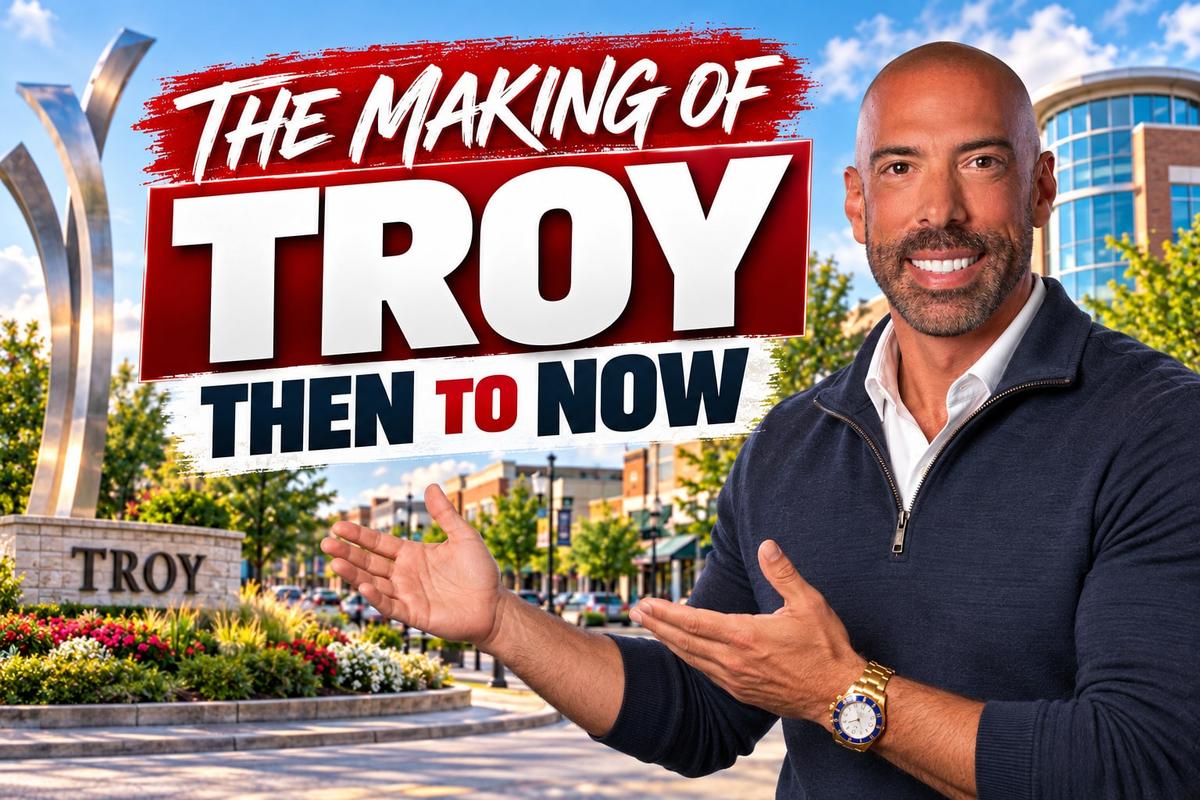
The Story Behind Troy: How It Became What It Is Today
In 1955, Troy was still a township of roughly 9,000 people, most of them farming land their grandparents had broken. Twenty years later, it was a city of 60,000 with a brand-new shopping mall, a corporate corridor along Big Beaver Road, and some of the highest property values in Michigan. That turnaround is one of the fastest municipal transformations in Michigan history, and most people who live there now have no idea it happened.
The story behind Troy and how it became what it is today starts much earlier than the postwar boom. It starts with a surveyor's chain, a land act, and a small group of settlers who picked this particular patch of Oakland County because the soil drained well.
From Frontier Township to Oakland County Powerhouse
The federal government opened this land for sale after the War of 1812. The first documented settler in what would become Troy Township was Ebenezer Cook, who arrived around 1819 and built near the Clinton River. By 1821, the Michigan Territory had officially organized Troy Township, named after Troy, New York, because so many early settlers had come from upstate New York and New England.
For the next century, Troy was farmland. Wheat, corn, and later dairy operations filled the rolling terrain between what are now major suburban corridors. The township had a few small villages — Sylvan Lake, Troy Corners, Clawson — but nothing that looked like a city center. Most residents traveled to Royal Oak or Pontiac for commerce.
Troy incorporated as a city in 1955, which is unusually late for a municipality this close to Detroit. That timing mattered. Incorporation gave local leaders control over zoning and development decisions right at the moment when suburbanization was accelerating fastest. They used that control aggressively.
The Big Beaver Corridor and the Somerset Era
The decision that changed Troy's economic identity more than any other was zoning Big Beaver Road as a premium commercial corridor in the late 1960s and early 1970s. City planners positioned it to attract corporate headquarters, not strip malls. Companies including Kmart, Kelly Services, and Delphi eventually placed major operations there. That single road became one of the most commercially valuable corridors in Michigan.
Somerset Mall opened in 1969 on Big Beaver at Coolidge Highway. It drew retailers that had never operated outside Detroit proper. The mall expanded in 1996 into what is now Somerset Collection, adding a luxury retail wing that drew Neiman Marcus, Saks Fifth Avenue, and dozens of other upscale tenants. Today Somerset Collection generates some of the highest retail sales per square foot of any shopping center in the Midwest, according to the Michigan Economic Development Corporation.
That commercial tax base let Troy invest in infrastructure and services at a level most suburban cities couldn't match. Lower residential tax burdens, well-maintained roads, and strong municipal services became part of the city's reputation, which in turn attracted more residents and more corporate investment. The cycle fed itself for decades.
Schools, Parks, and the Infrastructure That Stuck
Troy School District grew alongside the population surge. The district now operates multiple elementary schools, two middle schools, and two high schools. Athens High School and Troy High School both consistently rank among the top public high schools in Michigan based on state assessment data tracked by the Michigan Department of Education.
The city also built out Boulan Park, Troy Athens Recreation Center, and the Troy Nature Center during this growth period. Those facilities weren't afterthoughts. City planners in the 1970s and 1980s set aside land before it was developed, which is why Troy has 1,000+ acres of parkland today despite being one of Oakland County's most densely built cities.
The Dodge Park area along the Clinton River Trail connects to a broader Oakland County trail network that wasn't imaginable when Ebenezer Cook arrived on that creek bank in 1819.
Why It Still Matters Today
The story behind Troy and how it became what it is today is really a story about decisions made under pressure. Incorporation in 1955 could have gone differently. The Big Beaver zoning could have been strip commercial. Somerset could have been a discount center. Each of those choices compounded over decades into the city people move to and stay in now.
If you're thinking about buying or relocating in Metro Detroit, understanding why a city looks the way it does helps you evaluate it honestly. Troy's commercial strength funds its municipal services. Its late incorporation gave it planning flexibility that older cities didn't have. Its park system reflects intentional land banking, not luck.
History isn't decoration. In real estate, it's context.
For more on how Southeast Michigan communities compare, visit our communities page.
Frequently Asked Questions
When did Troy, Michigan officially become a city?
Troy incorporated as a city in 1955, having previously been organized as a township since 1821. The timing of incorporation gave local leaders zoning authority at the start of Michigan's postwar suburban expansion, which shaped the city's development significantly.
How did Somerset Collection become such a major retail destination?
Somerset Mall opened in 1969 on Big Beaver Road and expanded in 1996 into the two-building Somerset Collection. The city's decision to zone Big Beaver Road for premium commercial use attracted high-end retailers, and the center now ranks among the top-performing shopping centers by sales per square foot in the Midwest.
What school district serves Troy, Michigan?
Troy School District serves most of the city, operating Athens High School and Troy High School along with several middle and elementary schools. Both high schools consistently rank among the top public schools in Michigan based on state assessment data from the Michigan Department of Education.
Sources
• Michigan Economic Development Corporation
• Michigan Department of Education
Related reading
• The Whitney Detroit History: The Gilded Age Mansion That Still Holds Its Secrets
• Gateway to Freedom: Detroit's Powerful Monument to the Underground Railroad
• The Guardian Building: The Story Behind Detroit's 'Cathedral of Finance'
Homes for Sale in These Areas
Troy
Oakland County
Stay Updated
Get market insights, tips, and news from the MARK Z team.