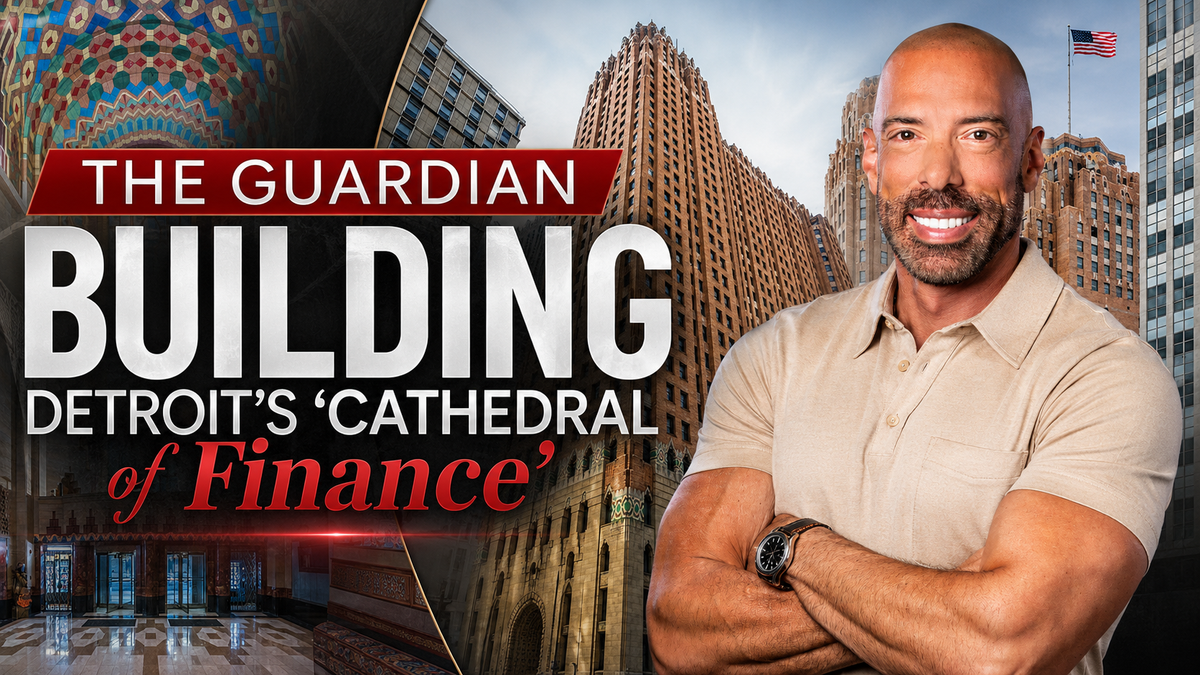
The Guardian Building: The Story Behind Detroit's 'Cathedral of Finance'
In 1929, workers finished installing hand-laid Pewabic tiles above the Griswold Street entrance of a new skyscraper in downtown Detroit. The semi-dome they covered looked less like the entrance to a bank headquarters and more like the threshold of a cathedral. That was exactly the point.
The Guardian Building: The Story Behind Detroit's 'Cathedral of Finance' begins with a city at the absolute peak of its confidence. Detroit in the 1920s was one of the most powerful industrial cities on earth. The auto industry had made it rich, and that wealth was looking for somewhere to go.
Wirt C. Rowland and the Commission That Changed American Architecture
The Union Trust Company, a newly organized banking group, wanted a headquarters that would say something. They hired architect Wirt C. Rowland, a Michigan architect working with the firm Smith, Hinchman and Grylls, and told him to build something that matched the ambition of the era.
Rowland delivered a 40-story tower completed in 1929 that became one of the finest examples of Art Deco architecture in the United States. He used a color palette of deep orange, brick red, and Pewabic blue that no one had dared to put on a skyscraper before. The nickname "Cathedral of Finance" followed almost immediately, and it stuck because it was accurate. Walking through the main entrance on Griswold Street, you are not in an office building. You are in something closer to a shrine.
Every material in the building came from Michigan. Michigan architects designed it. Michigan contractors built it. Michigan artisans finished it by hand. Rowland insisted on this, and it shows. The Griswold Street entrance dome was tiled by Pewabic Pottery, the Detroit studio founded by Mary Chase Stratton, whose ceramic work appears in buildings across the country but never more dramatically than here. Michigan artist Ezra Winter designed the large glass mosaic in the main lobby and the mural in the original banking hall.
What You See When You Walk Inside
The lobby of the Guardian Building stops people mid-step. The ceiling vaults upward in bands of orange and cream Rookwood tile. Geometric patterns cover every surface. The light, the scale, and the color all arrive at once.
Rowland rejected the European-influenced Beaux-Arts style that dominated American commercial architecture at the time. He drew instead on Native American and Mayan motifs, weaving them into the Art Deco geometry in a way that felt new and unmistakably American. For 1929, this was a radical choice.
The banking hall where Union Trust once processed deposits now hosts events and tours. Standing in it, you can still feel what Rowland and his clients were trying to communicate: that Detroit was not a second-tier city borrowing ideas from somewhere else. Detroit was originating them.
A National Historic Landmark in the Middle of the City
The National Park Service designated the Guardian Building a National Historic Landmark, which is the highest honor the federal government gives to a historic structure. The building is not just significant to Detroit. Architectural historians cite it as one of the great Art Deco buildings in the country, alongside structures in New York and Chicago that get far more international attention.
The Guardian Building: The Story Behind Detroit's 'Cathedral of Finance' is also a story about timing. The building opened in 1929, the same year the stock market crashed. Union Trust eventually failed during the Depression. The building changed hands several times over the following decades. Wayne County now owns it, and tenants occupy office space throughout the tower while the ground floor remains open for tours and public events.
Why It Still Matters to Metro Detroit Residents Today
For anyone living in Metro Detroit, the Guardian Building is a direct line to the era when this region set the pace for the rest of the country. The confidence that produced it, the craftspeople who built it, and the architect who refused to copy anyone else are all woven into the tile and stone.
Residents from Novi to Ann Arbor make the drive downtown specifically to see this building. It photographs well from the outside, but photographs cannot prepare you for the interior. The lobby has to be experienced in person to make sense.
If you want to understand why Metro Detroit has the architectural bones it has, and why people who grew up here defend this region with such conviction, start at the corner of Griswold and Congress. Look up at the semi-dome above the entrance. Rowland put everything Detroit believed about itself into that arch, and it has held up for nearly a hundred years.
For more on Metro Detroit history and local resources, visit the Z Real Estate Experts blog.
Frequently Asked Questions
Where exactly is the Guardian Building located in Detroit?
The Guardian Building sits at 500 Griswold Street in downtown Detroit, at the corner of Griswold and Congress Street. It is within walking distance of Campus Martius Park and accessible from several downtown parking structures.
Can the public visit the inside of the Guardian Building?
Yes. The lobby and banking hall are open to the public during regular business hours, and guided tours are available. The building hosts private events in the historic banking hall, so checking ahead before visiting is a good idea if you want full access.
Who designed the Guardian Building and when was it completed?
Architect Wirt C. Rowland, working with the Detroit firm Smith, Hinchman and Grylls, designed the building for the Union Trust Company. Construction finished in 1929, making it a product of Detroit's Roaring Twenties prosperity, just before the stock market crash that same year.
Homes for Sale in These Areas
Stay Updated
Get market insights, tips, and news from the MARK Z team.