The Story Behind the Renaissance Center: How Detroit Tried to Rebuild Its Future in 1977
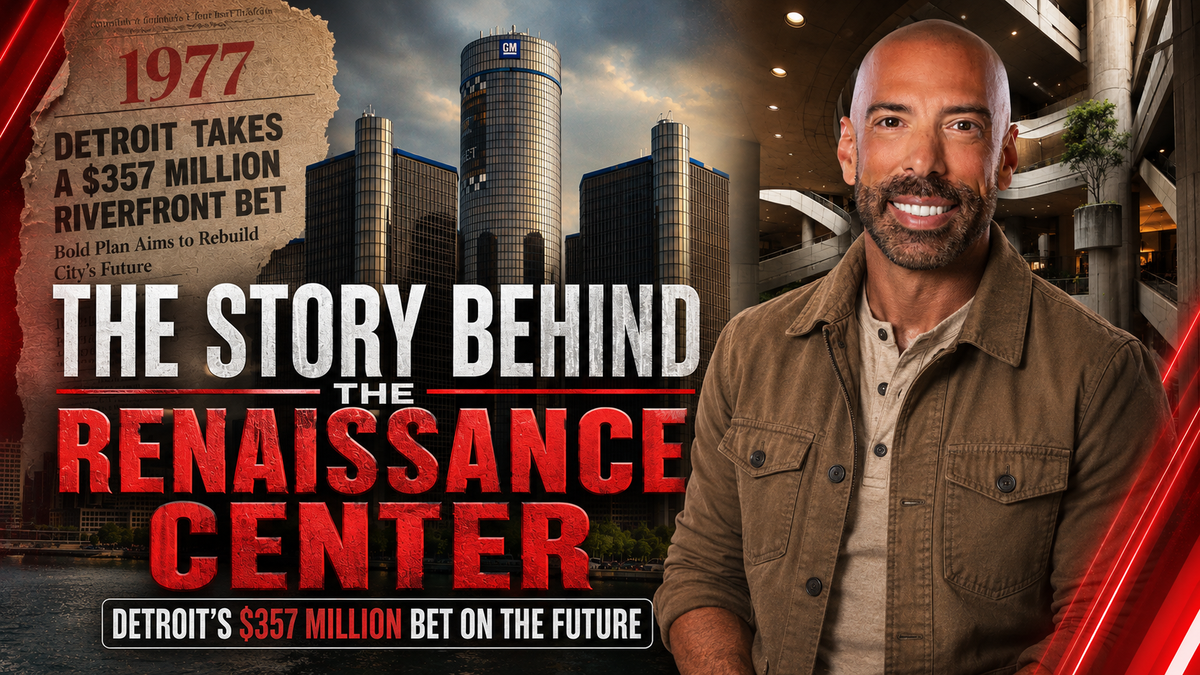
It was 1971, and Henry Ford II was watching Detroit die.
The 1967 uprising had left 43 people dead and entire blocks of the city gutted. White flight had hollowed out neighborhoods that once teemed with autoworkers and their families. Downtown retailers were boarding up windows. The tax base was collapsing. And Ford — heir to the most famous automotive dynasty in American history — decided he wasn't going to just watch it happen.
What he built in response became one of the most dramatic, debated, and ultimately transformative architectural gambles in American urban history. The story behind the Renaissance Center: how Detroit tried to rebuild its future in 1977 is not the sanitized civic pride story you'll find on a tourism brochure. It's messier, more fascinating, and far more human than that.
Henry Ford II and the $357 Million Bet
Ford didn't act alone, but he drove the project with a force of personality that brooked almost no opposition. He assembled a coalition of 51 Detroit-area businesses — including the Big Three automakers and major banks — each committing capital to what would become the Detroit Renaissance, Inc. private development group. The total investment: $357 million. At the time, it was the largest privately funded urban development project in U.S. history.
The site they chose was a largely vacant stretch of riverfront land on Jefferson Avenue — prime real estate that had been sitting underused while the rest of downtown crumbled around it. Ford's pitch was straightforward and almost defiantly optimistic: build something so impressive, so undeniably world-class, that it would force people to believe in Detroit again.
The architect selected was John Portman, a Atlanta-based visionary known for his soaring, interior-focused atrium hotels. His design called for a central 73-story cylindrical tower — what would become the Detroit Marriott at the Renaissance Center, still the tallest hotel in the Western Hemisphere at the time of its completion — surrounded by four smaller cylindrical office towers. The whole complex was encircled by a raised concrete berm, intended to create a self-contained urban village that felt secure and distinct from the street outside.
That berm would become one of the most criticized design decisions in Detroit's architectural history.
Why the Building Was Initially Considered a Failure
When the Renaissance Center opened in 1977, it was supposed to be a catalyst. What critics and users quickly noticed, however, was that the complex felt profoundly disconnected from the city it was meant to save.
The interior was notoriously disorienting — a labyrinth of corridors, levels, and curved walls that left visitors genuinely lost. Stories of people wandering for 20 minutes trying to find an exit became local legend. The concrete berm that surrounded the complex, meant to signal security and distinction, instead functioned as a wall between the Ren Cen and the Detroit streetscape. Rather than drawing foot traffic outward into downtown, the building absorbed it inward and kept it there.
Retailers struggled. Office tenants were slow to commit. The hotel, despite its spectacular atrium, faced stiff headwinds. By the early 1990s, the Renaissance Center had filed for bankruptcy protection, and the project that was meant to symbolize Detroit's resurrection was widely cited as a cautionary tale about top-down urban development divorced from neighborhood reality.
Detroit's population continued its long decline. The tax base kept shrinking. And the Ren Cen stood on the riverfront like a beautiful, bewildering question mark.
How GM's Purchase Changed Everything
In 1996, General Motors announced it would purchase the Renaissance Center complex and relocate its global headquarters there. The price: approximately $73 million — a fraction of the original development cost, and a sign of just how far the property had fallen in perceived value.
What GM did next was significant. The automaker invested over $500 million in renovations, redesigning the ground-level public spaces, opening the complex to the riverfront, and removing much of the visual and physical barrier between the building and the street. The berm that had isolated the Ren Cen for nearly two decades was reconfigured. The Detroit RiverWalk — now one of the most celebrated urban waterfronts in the Midwest — grew up around it.
Suddenly, the Renaissance Center was what Henry Ford II had always imagined it could be: a anchor. Not a solution to Detroit's challenges on its own, but a legitimate landmark around which investment, tourism, and civic identity could organize.
Today, when Metro Detroit residents from Novi to the east side drive downtown for a Tigers game or a riverfront walk, that cluster of cylindrical towers is the first thing they look for on the skyline. It's become inseparable from what Detroit looks like — and feels like — as a city.
Why It Still Matters Today
The story behind the Renaissance Center: how Detroit tried to rebuild its future in 1977 is really a story about what cities do when they're desperate, who gets to make those decisions, and how long it takes to know whether a big bet actually paid off.
Ford's coalition didn't save Detroit on its own. The city's recovery — partial, ongoing, complicated — came from many directions over many decades. But the Ren Cen established something harder to quantify: the idea that Detroit was still worth betting on. That private capital, however imperfectly deployed, could plant a flag on a riverfront and say *this place has a future*.
For anyone living in Metro Detroit today, that history is worth knowing. Not because it's a feel-good story — it isn't, entirely — but because it's an honest one. Cities are shaped by big gambles, political will, architectural vision, and sometimes just stubbornness. Detroit has all of those in abundance.
---
Frequently Asked Questions
Who funded the Renaissance Center when it was built?
The Renaissance Center was funded by a private coalition of 51 Detroit-area corporations organized under the Detroit Renaissance, Inc. group, led by Henry Ford II. The total investment was approximately $357 million, making it the largest privately funded urban development project in U.S. history at the time.
Why did General Motors buy the Renaissance Center?
GM purchased the Renaissance Center in 1996 for roughly $73 million as part of a plan to consolidate its global headquarters in downtown Detroit. The automaker subsequently invested over $500 million in renovations that opened the complex to the riverfront and made the building far more accessible and functional than the original design had allowed.
Can the public visit the Renaissance Center today?
Yes — the Renaissance Center is open to the public and includes restaurants, retail, the Detroit Marriott hotel, and direct access to the Detroit RiverWalk. GM's global headquarters occupies much of the office space, but the ground-level areas are designed for public use and are a popular destination for both locals and visitors exploring the riverfront.
Homes for Sale in These Areas
Stay Updated
Get market insights, tips, and news from the MARK Z team.