Detroit Had a Name Before Detroit: The Meaning of Waawiiyaataanong
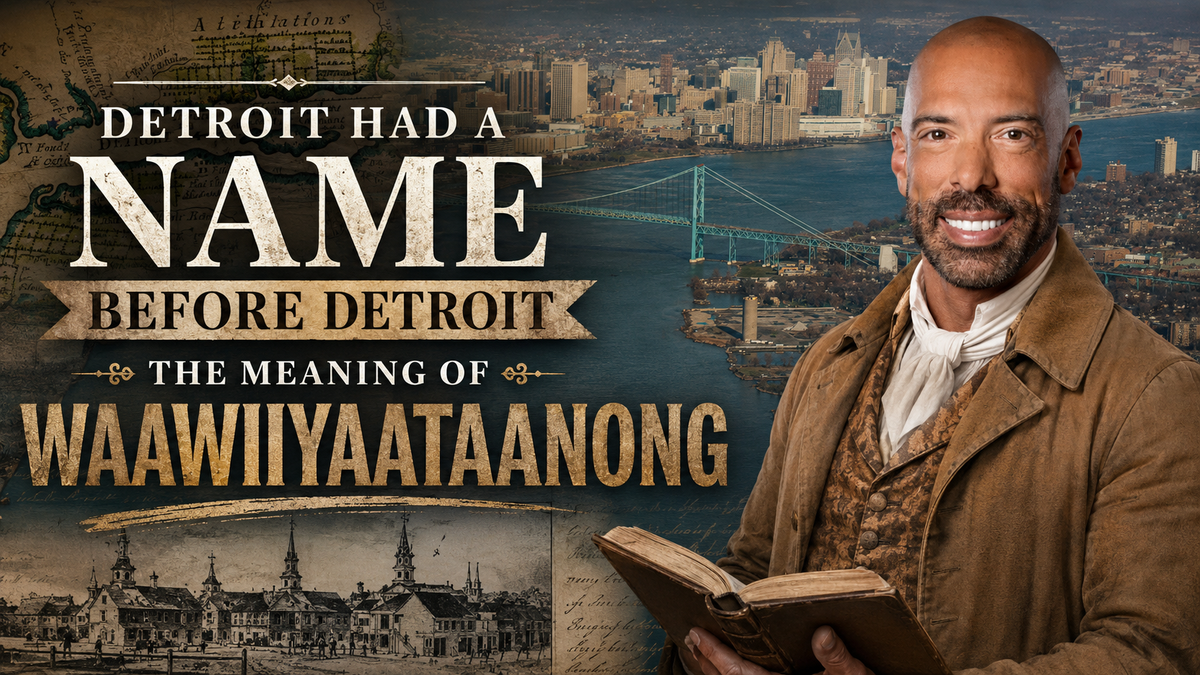
The river bends here. It has always bent here.
Long before Antoine de la Mothe Cadillac arrived in 1701 to establish Fort Pontchartrain du Détroit, long before any European cartographer drew a line on a map, the people who lived along this stretch of water had already named it for exactly what it was. They called it Waawiiyaataanong — an Anishinaabe word meaning "where the river bends." It was a practical, precise, and deeply accurate name for a place where the Detroit River curves in a way that shaped everything: trade routes, settlement patterns, and eventually one of the most consequential cities in North American history.
That name didn't disappear. It was just buried under centuries of new names, new borders, and new maps.
What Waawiiyaataanong Actually Means
The Waawiiyaataanong Detroit meaning is straightforward once you understand its linguistic roots. The word comes from the Anishinaabe language — specifically Ojibwe — and its core meaning describes the physical geography of the place itself: the distinctive curve in the Detroit River as it flows between what is now Michigan and Ontario.
This wasn't a poetic or ceremonial name invented after the fact. It was functional geography. Indigenous peoples across the Great Lakes region used place names as navigation tools and landmarks. Waawiiyaataanong told you where you were and, just as importantly, how to find it again. It described a real, observable feature of the land that would have been immediately recognizable to anyone traveling the river.
Several Indigenous nations were present in this region before and during European contact, including the Anishinaabe, the Wyandot (Wendat), the Potawatomi, the Odawa, and the Ojibwe. These were distinct nations with distinct languages, territories, and histories — not a single undifferentiated group. The river bend they named wasn't a wilderness. It was a known place, with established communities, trade networks, and long-standing relationships to the land.
The French Renamed It — But the River Didn't Move
When Cadillac's expedition arrived and established a fort, the French named the waterway la rivière du Détroit — "the river of the strait." That name stuck, and it eventually became the basis for the city's name. But renaming a river doesn't change its shape. The bend that gave Waawiiyaataanong its name is still there. You can see it on any satellite map of Detroit today, just south of downtown, where the river curves west before straightening toward Lake Erie.
What the French renamed, they also restructured. Fort Pontchartrain became a trading post, then a settlement, then a city. Indigenous nations who had lived in the region for generations were steadily displaced — through treaties, through conflict, and through the simple, grinding pressure of colonial expansion. The Waawiiyaataanong they had named became, legally and politically, someone else's land.
The Henry Ford museum's historical collections have documented this displacement and acknowledge that Metro Detroit sits on land with a history that predates the modern city map by a very long time. That acknowledgment matters — not as a guilt exercise, but as an accurate accounting of what happened here.
Why It Still Matters to People Who Live Here Now
You don't have to be a historian to find this relevant. If you live in Metro Detroit — whether in Novi, Birmingham, Ann Arbor, or anywhere else in the region — you're living on land with a layered past that the street grid doesn't always reflect.
Understanding the Waawiiyaataanong Detroit meaning is part of understanding the full history of this place. It's the difference between knowing Detroit was founded in 1701 and knowing that 1701 was not the beginning — it was a transition point in a much longer story.
Local schools, libraries, and institutions have increasingly incorporated this history into their programming. The Michigan state government officially acknowledged tribal sovereignty and the historical presence of Indigenous nations. These aren't symbolic gestures. They're recognitions that the land beneath Detroit's freeways and neighborhoods was never empty or unnamed.
For residents, knowing this history adds dimension to the place you call home. The river that defines Detroit's southern boundary wasn't just a useful geographic feature for European settlers. It had been a landmark, a resource, and a home for people long before any of us arrived.
---
Frequently Asked Questions
What does Waawiiyaataanong mean in English?
Waawiiyaataanong is an Anishinaabe (Ojibwe) word meaning "where the river bends." It refers to the distinctive curve in the Detroit River and was used by Indigenous nations to identify and navigate this specific location long before European settlement.
Which Indigenous nations lived in the Detroit area before colonization?
Several distinct nations had a presence in the Detroit region, including the Anishinaabe, Ojibwe, Odawa, Potawatomi, and Wyandot (Wendat). These were separate peoples with their own languages, governance, and territorial relationships — not a single unified group.
Is Waawiiyaataanong still used today?
Yes. The name Waawiiyaataanong is still used by Indigenous communities, scholars, and land acknowledgment statements to recognize the pre-colonial history of the Detroit area. Its use is a factual and respectful reference to the place's documented history before French colonization in 1701.
Homes for Sale in These Areas
Detroit
Ann Arbor
Novi
Birmingham
Stay Updated
Get market insights, tips, and news from the MARK Z team.