The Building Where the Assembly Line Was Born: Ford's Highland Park Plant
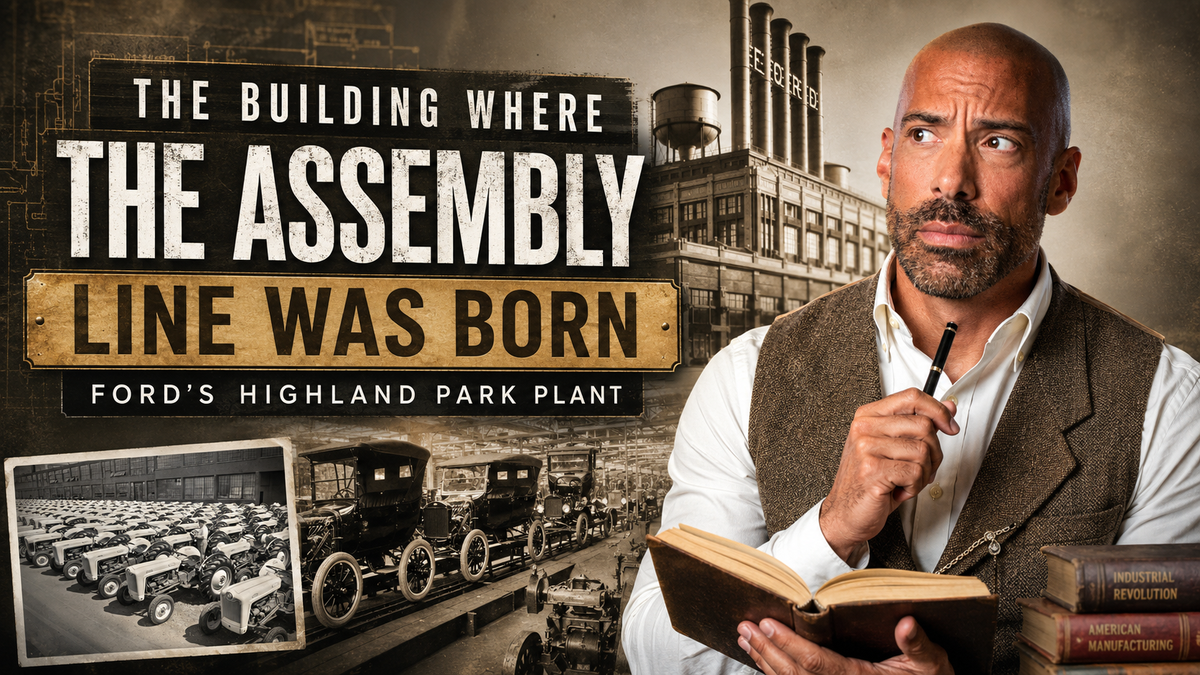
On October 7, 1913, workers at a Ford factory in Highland Park, Michigan strung a rope to a Model T chassis and dragged it slowly down the factory floor. Other workers stood at fixed stations and bolted on parts as it passed. The whole thing looked almost comically simple. Within a year, it had made most of the world's manufacturing methods obsolete.
That rope pull became the moving assembly line — and the building where it happened, the Highland Park Ford plant assembly line facility, is one of the most consequential structures ever built in the United States. It didn't just change how Ford made cars. It changed how the world makes everything.
A Factory Built for Something New
Ford's Highland Park Plant opened in 1910, designed by architect Albert Kahn and commissioned by Henry Ford specifically to build the Model T at scale. Kahn's design was revolutionary on its own — massive windows flooded the floor with natural light, and the reinforced concrete frame could support the weight of machinery that older brick factories couldn't handle.
But the building was really just the stage. The performance came three years later.
By 1913, Ford's engineers — Charles Sorensen and Clarence Avery among the key figures — had been studying bottlenecks in production. Making a Model T still took over 12 hours of labor per vehicle. That was too slow, too expensive, and too dependent on skilled craftsmen who could command their own wages. Ford wanted volume. He wanted a car every American worker could afford to buy. To get there, he needed to rethink the entire process from the ground up.
The solution they landed on: don't move the workers to the work. Move the work to the workers.
What the Moving Assembly Line Actually Changed
The Highland Park Ford plant assembly line didn't just speed things up — it restructured the relationship between labor, capital, and time in ways that economists are still writing about.
Within months of implementing the moving line, the time to assemble a Model T chassis dropped from over 12 hours to 93 minutes. Ford's output exploded. By 1914, Highland Park was producing more cars than all other American automakers combined.
That efficiency created a surplus that Ford famously plowed back into wages — the $5 workday announced in January 1914, more than double the going rate. It drew workers from across the country and around the world to Metro Detroit, reshaping the region's population and economy for generations. The assembly line didn't just build cars. It built the middle class, at least in part, right here in Michigan.
The method spread fast. Other industries — appliances, food processing, electronics — adopted variations of what Ford's team figured out on that Highland Park floor. The moving assembly line is one of a handful of genuine manufacturing innovations that you can trace a straight line from to the modern global economy.
The Site Today and Its Place in Highland Park
Highland Park is an independent city completely surrounded by Detroit, and it carries a history far larger than its 2.9 square miles suggest. The original Highland Park Ford plant complex still stands at Woodward Avenue and Manchester Street. The main building — that Albert Kahn-designed structure — is recognized by the National Park Service as a National Historic Landmark.
It's not a museum. It's not a tourist attraction with a gift shop. It's a real building, in a real neighborhood, that most people drive past without knowing what happened inside it. That's actually part of what makes it worth knowing about. The Highland Park Ford plant assembly line story isn't behind glass somewhere — it's right there on Woodward, the same avenue that connects the region's auto history from one end to the other.
For anyone who lives in Metro Detroit, this is your history in a direct and specific way. The prosperity that built this region's neighborhoods, its parks, its infrastructure — a meaningful share of it traces back to that rope pull in October 1913.
Why It Still Matters Today
Metro Detroit's identity is inseparable from the auto industry, and the auto industry's identity is inseparable from what Ford's team built at Highland Park. When you hear debates today about automation, about labor and wages, about how technology reshapes work — those conversations started, in a very real sense, in this building.
Understanding that history doesn't just make for good conversation. It gives context to why this region developed the way it did, why certain corridors and communities grew when they did, and what the area's economic DNA actually looks like. That context matters whether you're a longtime resident, a newcomer to the area, or someone trying to understand what makes Metro Detroit different from anywhere else in the country.
The answer, at least in part, is: this.
---
Frequently Asked Questions
When did the Highland Park Ford plant open, and when was the moving assembly line introduced?
The Highland Park Ford Plant opened in 1910 and was designed by renowned industrial architect Albert Kahn. The moving assembly line was introduced there in 1913, with the first experimental rope-pulled chassis test occurring on October 7 of that year.
Can you visit the Highland Park Ford plant assembly line site today?
The building still stands at Woodward Avenue and Manchester Street in Highland Park and is designated a National Historic Landmark by the National Park Service. It is not currently open as a public museum, but the exterior and historical marker are publicly visible.
Why is the Highland Park plant historically significant compared to other Ford facilities?
While Ford operated several plants, Highland Park is specifically credited as the birthplace of the moving assembly line — the production method that reduced Model T assembly time from over 12 hours to under 2 hours and influenced manufacturing across virtually every industry worldwide. That distinction makes it one of the most historically significant industrial sites in the country.
Homes for Sale in These Areas
Highland Park
Detroit
Stay Updated
Get market insights, tips, and news from the MARK Z team.